
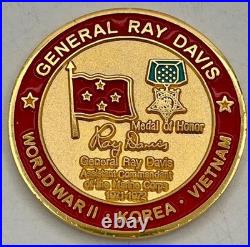





Medal of Honor citation. Rank and organization: Lieutenant Colonel. Marine Corps Commanding Officer, 1st Battalion, 7th Marines, 1st Marine Division Rein. Place and date: Vicinity Hagaru-ri, Korea, 1 through 4 December 1950. Entered service at: Atlanta, Ga. Born: January 13, 1915, Fitzgerald, Ga. For conspicuous gallantry and intrepidity at the risk of his life above and beyond the call of duty as commanding officer of the 1st Battalion, in action against enemy aggressor forces. Although keenly aware that the operation involved breaking through a surrounding enemy and advancing 8 miles along primitive icy trails in the bitter cold with every passage disputed by a savage and determined foe, Lt. Davis boldly led his Battalion into the attack in a daring attempt to relieve a beleaguered rifle company and to seize, hold, and defend a vital mountain pass controlling the only route available for two Marine Regiments in danger of being cut off by numerically superior hostile forces during their re-deployment to the port of Hungnam. When the Battalion immediately encountered strong opposition from entrenched enemy forces commanding high ground in the path of the advance, he promptly spearheaded his unit in a fierce attack up the steep, ice-covered slopes in the face of withering fire and, personally leading the assault groups in a hand-to-hand encounter, drove the hostile troops from their positions, rested his men, and reconnoitered the area under enemy fire to determine the best route for continuing the mission. Always in the thick of the fighting Lt. Davis led his Battalion over 3 successive ridges in the deep snow in continuous attacks against the enemy and, constantly inspiring and encouraging his men throughout the night, brought his unit to a point within 1,500 yards of the surrounded rifle company by daybreak. Although knocked to the ground when a shell fragment struck his helmet and 2 bullets pierced his clothing, he arose and fought his way forward at the head of his men until he reached the isolated Marines. On the following morning, he bravely led his Battalion in securing the vital mountain pass from a strongly entrenched and numerically superior hostile force, carrying all his wounded with him, including 22 litter cases and numerous ambulatory patients. Despite repeated savage and heavy assaults by the enemy, he stubbornly held the vital terrain until the two Regiments of the Division had deployed through the pass and, on the morning of 4 December, led his Battalion into Hagaru-ri intact. By his superb leadership, outstanding courage, and brilliant tactical ability, Lt. Davis was directly instrumental in saving the beleaguered rifle company from complete annihilation and enabled the two Marine Regiments to escape possible destruction. His valiant devotion to duty and unyielding fighting spirit in the face of almost insurmountable odds enhance and sustain the highest traditions of the U. The President of the United States takes pleasure in presenting the Navy Cross to Raymond Gilbert Davis (0-5831), Major, U. Marine Corps, for extraordinary heroism as Commanding Officer of the First Battalion, First Marines, FIRST Marine Division, in action against enemy Japanese forces on Peleliu, Palau Islands from 15 to September 22, 1944. Although wounded during the first hour of landing, Major Davis refused evacuation to remain with his Battalion’s assault elements in many hazardous missions. On one occasion, when large gaps occurred in our front lines as the result of heavy casualties, and his right flank company was disorganized by point-blank enemy cannon fire following a successful nine hundred yard penetration through heavily defended lines, he rallied and personally led combined troops into these gaps to establish contact and maintain hasty defensive positions for the remainder of the night. Despite many casualties from close-range sniper fire, he remained in the vicinity of the front lines, coordinating artillery and Naval gunfire support with such effect that several determined counterattacks were repulsed. His outstanding courage, devotion to duty and leadership were in keeping with the highest traditions of the United States Naval Service. First Silver Star citation. The President of the United States of America, authorized by Act of Congress July 9, 1918, takes pleasure in presenting the Silver Star (Army Award) to Lieutenant Colonel Raymond Gilbert Davis (MCSN: 0-5831), United States Marine Corps, for conspicuous gallantry and intrepidity in action against the enemy in Korea during the period 2 November to 8 November 1950. Lieutenant Colonel Davis was serving as Commanding Officer of the First Battalion, Seventh Marines, FIRST Marine Division on 3 November 1950. At about 0130, 3 November the enemy conducted a fierce, coordinated night attack against the First Battalion, Seventh Marines. Lieutenant Colonel Davis moved from point to point on the line wherever there was danger of the enemy breaking through, continually exposing himself to heavy enemy small arms and mortar fire without personal regard for his own safety. His display of leadership, initiative and courage was a constant inspiration to the officers and men about him. It was through his actions that the lines held and the enemy was repulsed. During the daylight hours of 3 November Lieutenant Colonel Davis maneuvered elements of his command in such a manner as to route the enemy. Once again Lieutenant Colonel Davis’ display of leadership and courage acted as an inspiration to the officers and men of his command. It was a direct result of Lieutenant Colonel Davis’ actions that the First Battalion was able to break through and continue the attack in its zone of action. Second Silver Star citation. The President of the United States of America takes pleasure in presenting a Gold Star in lieu of a Second Award of the Silver Star to Lieutenant Colonel Raymond Gilbert Davis (MCSN: 0-5831), United States Marine Corps, for conspicuous gallantry and intrepidity as Commanding Officer of the First Battalion, Seventh Marines, FIRST Marine Division (Reinforced), in action against enemy aggressor forces in Korea on 30 September 1950. Assigned the task of seizing two hills located at the southern end of the Seoul-Uijongbu corridor, Lieutenant Colonel Davis boldly led his battalion against a well-entrenched enemy force in the face of hostile small-arms, automatic-weapons and mortar fire. Keenly aware that the unit had been assembled and organized only six weeks previously and that this was its first attack, he advanced with the assault elements and, moving from platoon to platoon to encourage the men, inspired his battalion to rout the enemy and capture its objective quickly. By his marked courage, brilliant leadership and steadfast devotion to duty, Lieutenant Colonel Davis upheld the highest traditions of the United States Naval Service.